
How to Use Shohei Ohtani’s Harada Method to Score a 1600 on the SAT: A 64-Cell Blueprint for High-Impact Results
The Harada Method as a Foundation for SAT Excellence
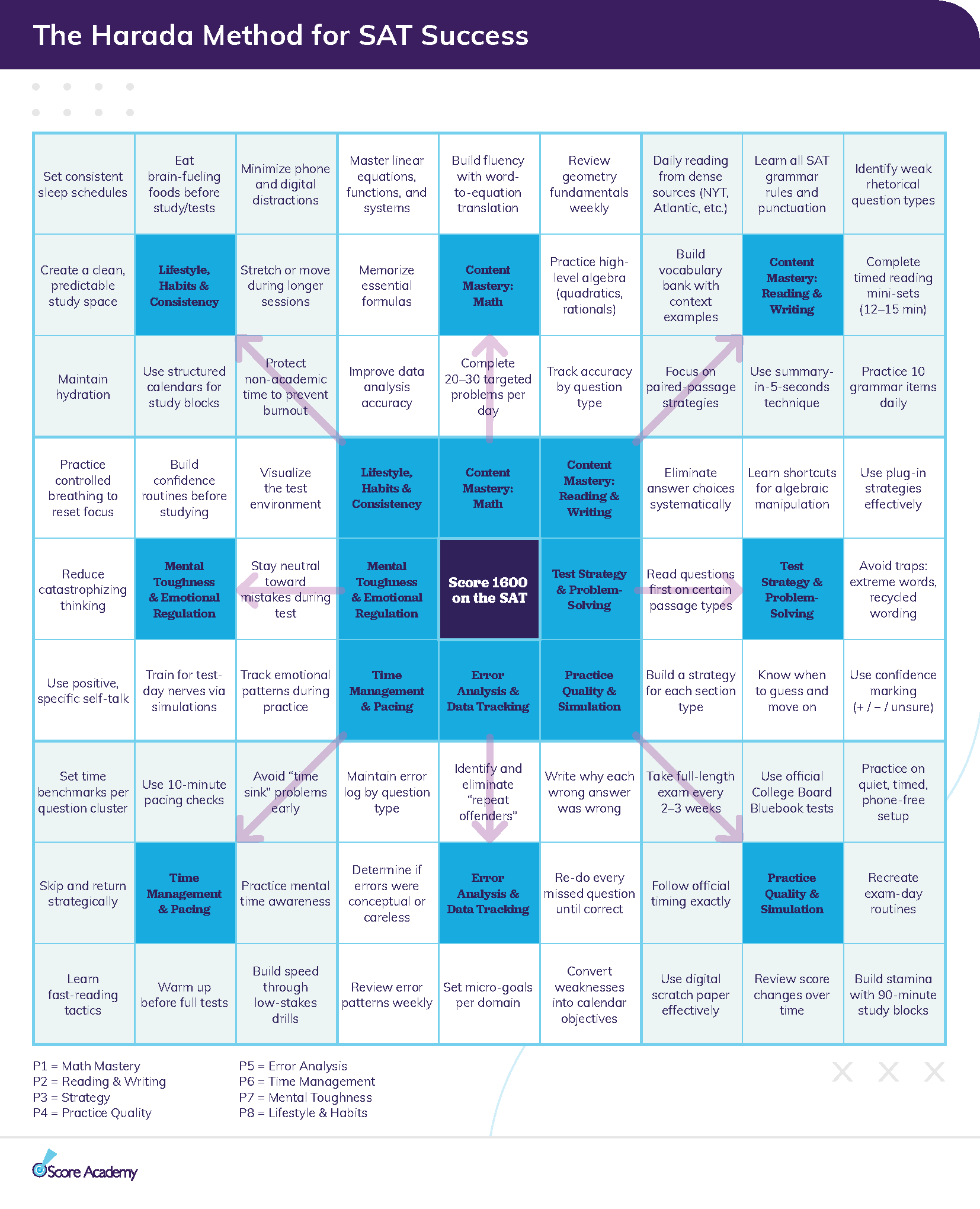
Shohei Ohtani is one of the most extraordinary athletes in modern sports—a two-way Major League Baseball superstar who excels simultaneously as an elite pitcher and a top power hitter, something virtually unseen since Babe Ruth. Long before he reached global prominence, Ohtani engineered his future using a structured performance system known as the Harada Method. Developed by Japanese coach Takashi Harada, the method guides individuals to break a major goal into eight core pillars, each supported by eight concrete, daily behaviors. The result is a 64-cell “action matrix” that turns ambition into disciplined execution. Ohtani used this framework in high school to map his path to becoming the number-one draft pick—demonstrating how extreme clarity, habit design, and accountability can compound into world-class outcomes. That same system can be adapted by any student pursuing a complex objective, including earning a 1600 on the SAT.
Shohei Ohtani’s 64-cell “dream sheet” demonstrated a universal truth: extraordinary outcomes come from clear goals, structured routines, and disciplined execution. His grid was not motivational—it was operational.
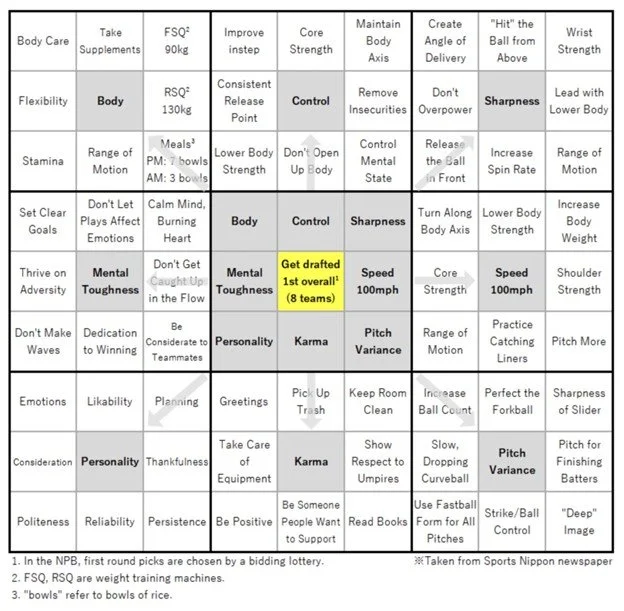
A student targeting a 1600 SAT score can use this exact approach. Instead of vague intentions (“I want to improve”), the student constructs a system of repeatable habits that compound into quantifiable gains.
This model works for all score goals, but the 1600 benchmark offers a powerful combination of ambition, realism, and competitiveness—particularly for selective universities and major merit scholarships.
Step 1: Put the Goal in the Center
“Score 1600 on the SAT.”
Attach a deadline:
“Score 1600 on the March/May/June SAT.”
Step 2: Define the 8 Pillars of a 1600-Level SAT Test Taker
Below are the recommended pillars derived from the skill set, mindset, and habits consistently seen in students who break the 1600 threshold.
The 8 Pillars
Content Mastery: Math
Content Mastery: Reading & Writing
Test Strategy & Problem-Solving
Practice Quality & Simulation Routine
Error Analysis & Data Tracking
Time Management & Pacing Control
Mindset, Confidence, & Emotional Regulation
Lifestyle, Habits, and Consistency
Each pillar will hold eight concrete, controllable actions—your 64-cell grid.

Step 3: Fill the 64 Cells (8 Tasks per Pillar)
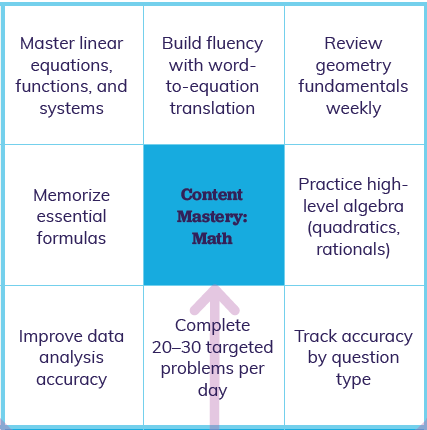
Pillar 1: Content Mastery – Math
Target: Convert mid-range mistakes into strengths; master the high-yield domains.
Master linear equations, functions, and systems
Build fluency with word-to-equation translation
Review geometry fundamentals weekly
Memorize essential formulas (and know when not to use them)
Practice high-level algebra (rational expressions, quadratics)
Improve data analysis accuracy
Complete 20–30 targeted math problems per day
Track accuracy by question type
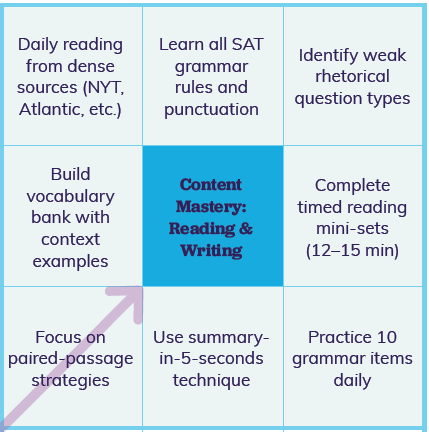
Pillar 2: Content Mastery – Reading & Writing
Target: Strengthen comprehension, grammar, logic, and evidence use.
Practice daily reading from dense sources (NYT, The Atlantic, Scientific American)
Learn all SAT grammar rules and punctuation patterns
Identify your weak rhetorical question types
Build a vocabulary bank with context-driven examples
Complete timed reading mini-sets (12–15 minutes)
Focus on paired-passage strategies
Implement a summary-in-5-seconds technique
Practice 10 grammar items daily
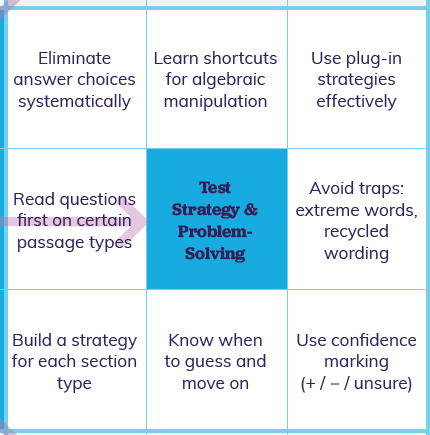
Pillar 3: Test Strategy & Problem-Solving
Target: Gain the tactical advantage the SAT rewards.
Eliminate answer choices systematically
Learn shortcuts for algebraic manipulation
Use plug-in and plug-in-numbers strategically
Read questions first on certain passage types
Avoid traps: extreme words, recycled wording, emotional language
Build a strategy for each section type
Determine when to guess and move on
Use confidence marking (+ / − / unsure)
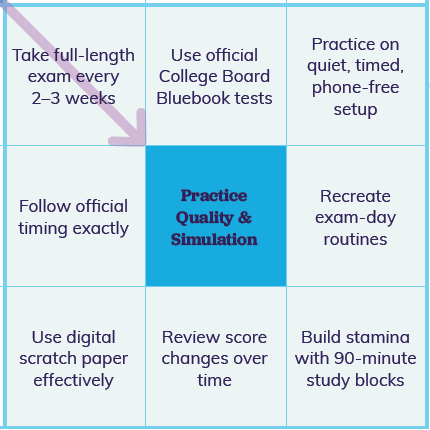
Pillar 4: Practice Quality & Simulation Routine
Target: High-fidelity practice replicating actual testing conditions.
Take a full-length exam every 2–3 weeks
Use official College Board Bluebook tests
Practice on a quiet, timed, phone-free setup
Follow the official timing exactly
Recreate exam-day routines (night before, morning of)
Use digital scratch paper effectively
Review score changes over time
Increase stamina with 90-minute study blocks
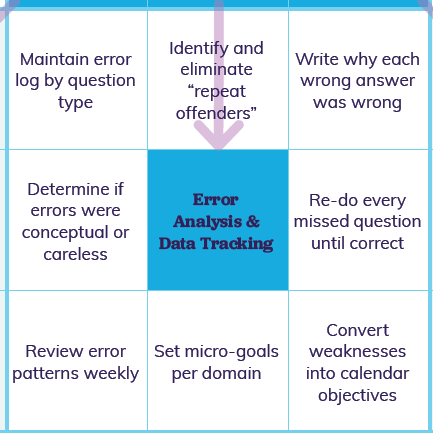
Pillar 5: Error Analysis & Data Tracking
Target: Turn every mistake into a score increase.
Maintain an error log categorized by question type
Identify “repeat offenders” and eliminate them
Write down why each wrong answer was wrong
Determine whether errors were conceptual or careless
Re-do every missed question until correct
Review error patterns weekly
Set micro-goals for each domain (ex: “80% accuracy on functions”)
Convert weaknesses into calendar-planned objectives
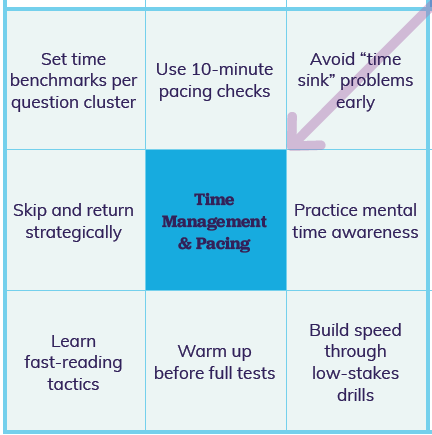
Pillar 6: Time Management & Pacing
Target: Control the clock rather than fight it.
Set time benchmarks per question cluster
Use 10-minute pacing checks
Avoid “time sink” problems early
Skip and return strategically=
Practice mental time awareness=
Learn fast-reading tactics for specific question types=
Warm up before full tests
Build speed through low-stakes drills
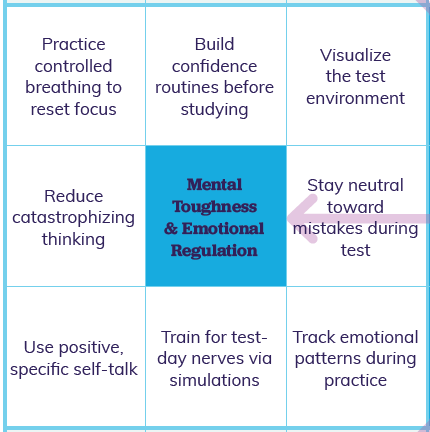
Pillar 7: Mental Toughness & Emotional Regulation
Target: Build resilience under pressure—a major differentiator.
Practice controlled breathing to reset focus
Build confidence routines before studying
Visualize the test environment
Reduce catastrophizing (“one bad question ruins everything”)
Maintain neutrality toward mistakes during the test
Use positive, specific self-talk (“I solve these well”)
Train for test-day nerves through simulations
Track emotional patterns during practice
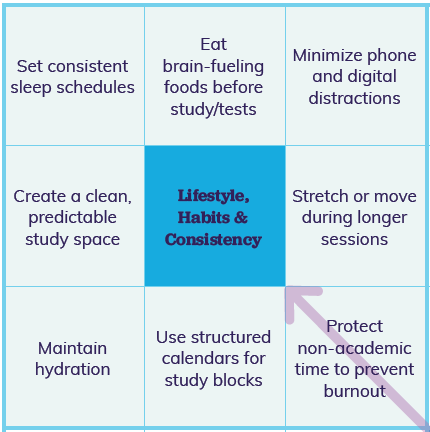
Pillar 8: Lifestyle, Habits, and Consistency
Target: Strengthen the physical and environmental foundations of learning.
Set consistent sleep schedules
Eat brain-fueling foods before study and test days
Minimize phone and digital distractions
Create a clean, predictable study environment
Stretch or move during longer study sessions
Maintain hydration
Use structured calendars for study blocks
Protect non-academic time to prevent burnout
The final product should look like this (which can be modified for any score goal):
Step 4: Convert the 64 Cells Into a Daily Accountability System
Just like Ohtani:
Daily Checklist – Identify 6–10 actions you’ll complete today.
Weekly Diary – Record what improved and what stayed stuck.
Monthly Review – Adjust strategies, reinforce what is working, discard what is not.
Score Benchmarking – Track every diagnostic and full-length test in a simple spreadsheet.
A 1600 comes from consistent, targeted, measurable work—never from volume alone.
Step 5: Recalibrate Every 4 Weeks
The key to achieving a 1600 is course correction, not just hard work.
If Reading is flat but Math is rising, shift the weight.
If timing collapses during the last 10 questions, restructure pacing drills.
High performers refine constantly.
Final Thoughts
Aiming for a 1600 on the SAT requires far more than practice tests. It requires a system, a structure, and habits that compound weekly. Shohei Ohtani’s 64-cell method is one of the most powerful frameworks a student can use to transform an ambitious score goal into a disciplined, actionable, and achievable plan.
