
How SAT/ACT Scores Can Turn $2,500 Into $240,000 of Free Tuition
Boston University announced on August 6, 2026 that families earning up to $200,000 with typical assets will pay no tuition, joining Harvard University, the Massachusetts Institute of Technology, Yale University, University of Pennsylvania, Emory University, and a dozen other selective private universities that have made similar commitments over the past two years. Princeton University and the University of Chicago have gone to $250,000. For most middle-class families, the tuition barrier at these schools is simply gone.
What has not gone away is the admissions barrier. These are schools admitting somewhere between 4% and 13% of applicants, which means the entire financial value of a free-tuition program is captured at a single moment: the admissions decision. And by the time that decision is made, almost everything in the application has been years in the making. Yet, one thing has not.
A strong test score is the lever a family can still achieve in a single season, and it costs a few thousand dollars. The seats it competes for are now worth as much as $240,000 in tuition.
Which free-tuition colleges require the SAT or ACT?
Here is the detail most of the news has missed: several of the most selective schools on the free-tuition list now require test scores, while others remain test-optional but may consider scores as part of the application.
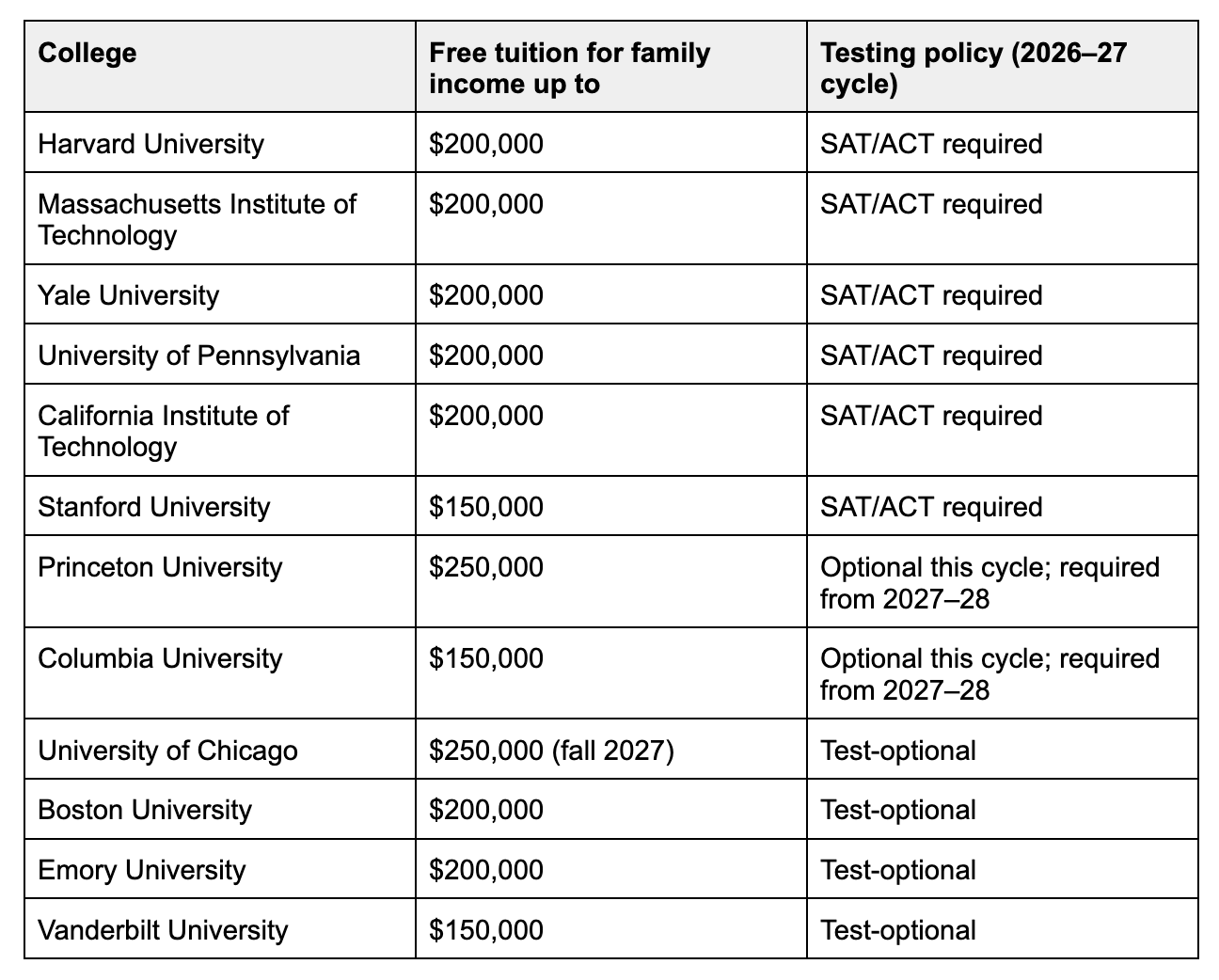
Sources: institutional financial aid announcements as compiled in reporting by Forbes and Road2College (July–August 2026); testing policies per each university's published requirements for the 2026–27 cycle. Both change by year; verify before applying.
At schools where aid is richest and odds are longest, the score is back on the table. They are part of a broader return to required testing that includes Brown University, Dartmouth College, Cornell University, and Georgetown University.
The test-optional entries on the list deserve equal attention, because test-optional is not test-blind. When test-optional colleges have disclosed outcomes by submission status, applicants who submitted scores were admitted at roughly twice the rate of those who did not: in the 2020–21 cycle, Emory University admitted 17% of applicants with scores against 8.6% without, Georgia Institute of Technology 22% against 10%, and the University of Georgia 49% against 26%, disclosures we examined in 3 reasons scores matter at test-optional colleges. The decision criterion, which we lay out in Test Optional: To Submit or Not to Submit, is simple: if your score falls within or above the school's middle-50% range (the 25th-75th percentile of admitted students), submit it. At selective universities, test-optional functions in practice as test-preferred.
The practical consequence is blunt. At a school admitting fewer than 10% of applicants, an application without a competitive score is incomplete, and an application with one has cleared the first credibility hurdle. That holds whether the school requires the score or merely welcomes it.
A few thousand dollars, competing for a $240,000 seat
We have made the investment case for test prep before: years ago we showed that SAT prep out-earns Warren Buffett when Florida's Bright Futures Scholarship is the payoff, an argument that still stands for any family targeting a state university. The free-tuition wave raises the stakes by an order of magnitude.
Tuition at the private universities on the above list runs $60,000 or more per year, so a free-tuition award is worth up to $240,000 across four years for an admitted, income-eligible family. Structured test preparation, by comparison, typically costs a few thousand dollars; most of our families spend less than $2,500.
Run it the way an investor would. Assume the family spends $2,500 on preparation in the fall of junior year, the student is admitted to a school on the list, and the family has a qualifying income. Tuition of $60,000 a year is then waived for four years, beginning roughly two years after the prep investment. Here is that outcome next to the same $2,500 left in the stock market:
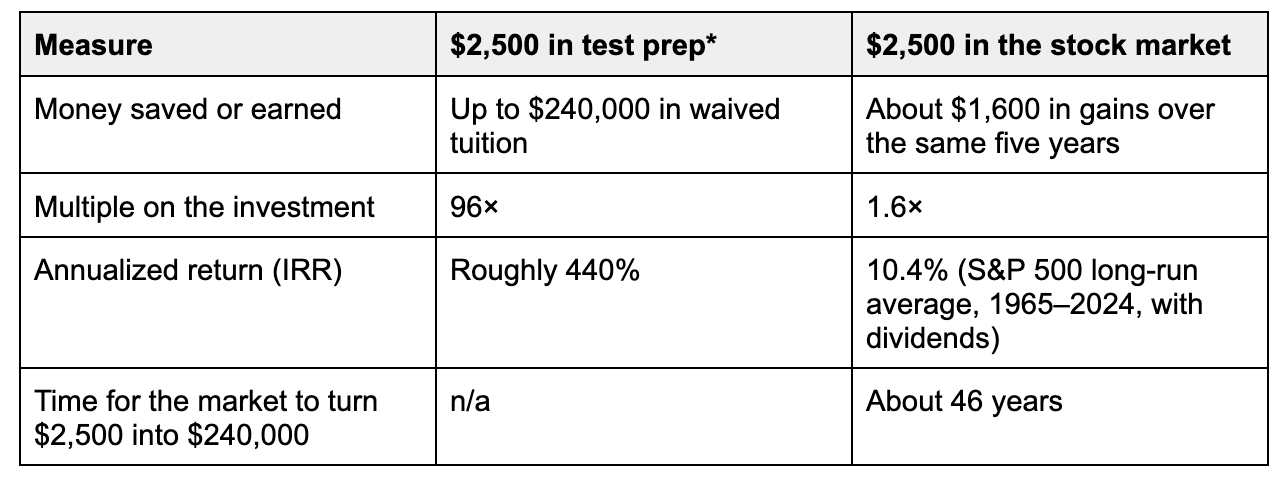
*Assumes admission and income eligibility, with tuition savings of $60,000 per year across four college years beginning two years after the prep spend. The IRR is the discount rate that equates $2,500 today with those four annual $60,000 savings. The S&P 500 figure is the long-run compounded annual return with dividends reported in Berkshire Hathaway's 2024 annual report; $2,500 compounding at 10.4% reaches about $4,100 in five years and would need about 46 years to reach $240,000.
An internal rate of return of 440% is not a number that exists anywhere else in a family's financial life, and it is fair to be suspicious. The right response is not to dismiss it but to discount it: the payoff is conditional on admission, and prep only improves odds, it does not set them to one. So discount hard. If a focused engagement changes the admissions outcome just one time in ten, the expected value of the $2,500 is still $24,000, nearly ten times its cost. No other purchase in the college process has that shape.
Two honest caveats, because the math only works when it is stated fairly:
First, prep does not buy admission; nothing does. What it buys is the points a student is missing. A junior sitting at 1380 with a transcript full of rigor does not need us to reach Emory University's range; the return belongs to the student at 1280 whose score has not caught up to their grades, where a focused engagement moves the application from incomplete to competitive. In our 40 years of doing this, that is the most common student we see.
Second, grades come first. No score rescues a weak transcript, and every school in that table assumes a demanding course load successfully completed. Test prep is the second investment, not the first. But it is the only major application variable still open in junior year, the one tied most directly to money: the same score that makes a student competitive at a free-tuition private also strengthens merit-aid offers at universities that weigh testing, and clears Florida's scholarship thresholds along the way.
Why junior year is the right time to raise a test score
By the spring of junior year, most of the application is already written. The GPA reflects three years of work, and the activity list reflects commitments made long ago. None of it can be meaningfully changed in a semester.
A test score can have an immediate effect. The SAT and ACT are learnable exams with finite content, known formats, and error patterns a good tutor diagnoses in the first two sessions. Effective preparation starts from an individual diagnostic rather than a generic class, which is the design principle behind our SAT preparation programs and ACT preparation programs. For sophomores, the play is even simpler: a real baseline test now, light skill-building through the year, and a focused push in the fall of junior year.
How to turn a test score into a shot at free tuition
For a family with a student entering sophomore or junior year, the sequence looks like this:
Confirm eligibility before anything else. Every free-tuition program has an income threshold and an asset test ("typical assets" exclude many families with businesses or rental property). Check the school's net price calculator before falling in love with a campus.
Establish a baseline. A real practice SAT or ACT, not a guess, tells you the gap between where the student is and the middle-50% range at each test-required or test-preferred school on the list.
Prep in a defined window, then retest. A focused engagement in the fall of junior year leaves room for a spring retake and, if needed, one more attempt in the summer. Scattering prep across two years dilutes it.
Let the score shape the strategy. A student who lands a strong score gains options: submitting everywhere, applying early with confidence, and competing where the aid is richest. Applying early is its own advantage, one we examine in why applying early has never mattered more.
The families who capture these opportunities are not the ones who spend the most. They start with a diagnostic, target the right ranges, and treat the score as what it now plainly is: a lever worth real money.
Frequently Asked Questions
Is SAT prep worth it if colleges offer free tuition?
Yes, and the free-tuition programs are precisely why. The aid is guaranteed for admitted students who qualify on income, but admission runs through highly selective review at schools that require or strongly favor test scores. A $2,500 prep investment competing for a seat worth up to $240,000 in tuition is a 96× multiple, an annualized return near 440% if it succeeds, against the stock market's long-run 10.4%.
Do the free-tuition colleges require SAT or ACT scores?
Many of the most selective ones do. For the 2026–27 cycle, Harvard University, the Massachusetts Institute of Technology, Yale University, the University of Pennsylvania, the California Institute of Technology, and Stanford University require scores, and Princeton University and Columbia University will require them beginning in 2027–28. A student targeting universities that offer free tuition under $200,000 of family income should plan on testing.
Should you submit SAT scores to a test-optional college?
Yes, whenever your score falls within or above the school's middle-50% range for admitted students. Test-optional colleges that have disclosed results by submission status admitted score-submitters at roughly twice the rate of non-submitters; in the 2020–21 cycle, Emory University admitted 17% of applicants with scores versus 8.6% without. Withhold a score only when it sits clearly below the school's published range.
Can a high test score make up for average grades?
No. Grades and course rigor remain the foundation of every application at every school on the free-tuition list. A strong score amplifies a solid transcript; it cannot substitute for one. The right sequence is grades first, then a focused testing push, which is why test prep delivers its best returns for students already performing in the classroom.
Score At The Top Learning Centers & Schools has been helping Florida families build strong academic foundations for over 40 years – from personalized SAT and ACT preparation to tutoring and academic coaching. To learn more, visit Score At The Top.
