
Most students should plan to take the official ACT two or three times. An ACT superscore combines a student's best section scores from multiple test dates, because each additional test is another chance to raise one section without risking the others. In Florida, that matters for more than college admissions: Bright Futures uses a student's highest ACT section scores across all his or her test dates, according to the Florida Department of Education.
ACT's own research shows why the second test date deserves a place on the calendar. The 448,462 students in the Class of 2026 who tested more than once had an average ACT superscore of 23.1, according to ACT's 2026 National Profile Report, and ACT's 2026 graduating class infographic reports that most of them raised their superscore by two or more points.
How the ACT superscore works
An ACT superscore takes a student's highest English, math, and reading scores from any official test dates and averages them into a new Composite, the 1–36 overall score. Since September 2025, the Composite and the superscore use those three sections only; science is optional and reported separately.
Take a student who scores 25 in English, 21 in math, and 24 in reading in October, a Composite of 23. In December the same student scores 23, 24, and 23, another 23. The superscore uses the 25 in English, 24 in math, and 24 in reading. After rounding, that is a 24, one point higher than either test day.
A student who sits once has the same superscore and Composite. The benefit begins with the second test.
What ACT's research found about multiple sittings
in a 2019 technical brief, ACT researchers Krista Mattern and Justine Radunzel compared most recent scores and superscores for the 1.9 million students in the Class of 2018. Each row in the table below is a different group of students, so read it across, not down:
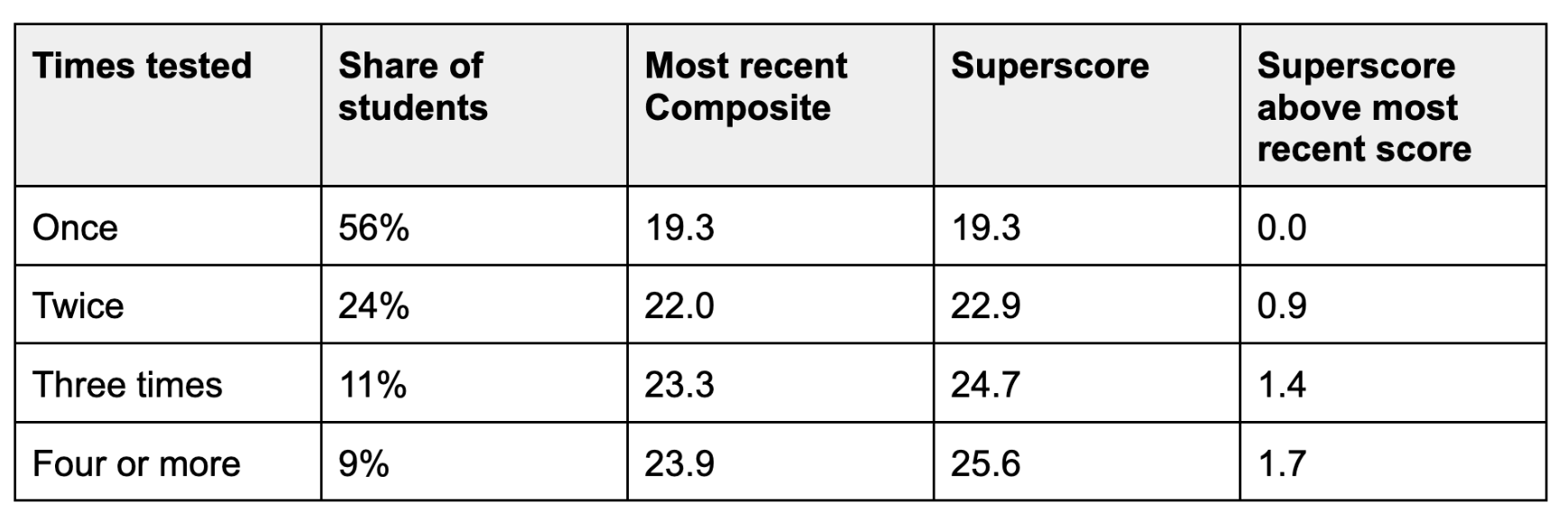
Within each group, the superscore ran ahead of the most recent score, and the difference was larger for students who tested more often. The step from two sittings to three (0.9 to 1.4) was bigger than the step from three to four or more (1.4 to 1.7). Part of that difference comes from simple variation: taking the best section from several tests produces a higher composite number than any single test. Part comes from students improving between sittings.
The rows also differ in ways the table does not immediately illustrate. Students who test four times are not a random sample of those who test once; they differ in preparation, school, and family resources. The 2018 data also comes from the four-section ACT, before science became optional.
In our experience, the second sitting is the most productive. The first official test result is often affected by nerves, unfamiliar timing, and a section that went badly for reasons unrelated to preparation. By the third sitting, further gains depend more on learning content.
Why Colleges and Bright Futures Superscore the ACT
Some parents worry that a superscore overstates a student's ability. In an earlier study summarized in the same brief, Mattern and colleagues found that superscores predicted first-year college grades slightly better than other ways of combining scores, and that students who tested more often earned higher college grades than their scores predicted. That study used the older four-section test, but it gives colleges a reasonable basis for superscoring.
The researchers offered one explanation: students willing to spend several Saturdays on a long exam may also be the students who attend faculty office hours and ask questions in class.
College policies vary. Many superscore, some use the highest single sitting, and a few require students to send every score. Our list of colleges that superscore the ACT shows current policies, and our guide on when to submit scores to test-optional schools covers what to send. Only the sittings a student sends can be combined, so students should send each sitting with one of their best section scores. ACT charges a fee for each score report.
For Florida students, Bright Futures uses the highest score in each ACT section across test dates, and it averages English, math, and reading for students who skip science, according to a 2025 Florida Department of Education memo. A student who needs a 24 or 25 for the Medallion award can work on one section at a time.
How many times should a student take the ACT?
Two or three official sittings fit most college-bound students. A fourth sitting makes sense when a student is close to a specific number, such as a Bright Futures threshold or a target college's middle range of admitted students' scores. Each sitting carries a registration fee and a Saturday of the student's time.
A sitting plan that uses the superscore well:
Take the first official ACT in the winter or spring of junior year, after some preparation, so the first score is useful.
Space sittings far enough apart to work on the weakest section from the last score report. Some consecutive national dates, such as September and October, are only four to five weeks apart, which works best for a student who is already close to the goal.
Focus each round of prep on one or two sections, since the superscore keeps the best scores from the others.
Use the summer after junior year, including the July date, for a final sitting when possible. Students applying Early Decision or Early Action in November can usually count only on September and October of senior year.
If a senior has sittings from before September 2025, when the Composite still included science, ask each college how it combines old and new scores.
ACT fee waivers cover up to two tests for eligible students, so register for both dates at the same time.
Families who book two dates in junior year and plan prep around the gap between them get the most from the superscore. Our ACT preparation team starts with a diagnostic and maps the sitting calendar, and our private ACT tutoring lets prep shift to whichever section the last sitting exposed as weak.
Frequently Asked Questions
What is an ACT superscore?
An ACT superscore is a Composite built from a student's highest English, math, and reading scores across all official sittings. Since September 2025, the superscore uses only those three sections. Students who test once have identical superscores and Composites, so the superscore helps only students who sit more than once.
How much does superscoring raise an ACT score?
In ACT's study of the Class of 2018, superscores ran 0.9 points above the most recent score for students who tested twice, 1.4 points for three sittings, and 1.7 for four or more. Those figures compare against the most recent test; measured from the first test, ACT reports most 2026 retesters gained two or more points.
How many times should you take the ACT?
Most students should plan two or three official sittings. In ACT's data, the superscore advantage was larger for students who tested more often, with a smaller step after three sittings. A fourth sitting makes sense when a student is close to a specific target, such as a Bright Futures threshold or a college's score range.
Does Bright Futures superscore the ACT?
Yes. Florida's Bright Futures program uses the highest score in each ACT section across test dates, according to the Florida Department of Education. Students who skip the optional science section have English, math, and reading averaged. ACT and SAT scores cannot be mixed, so a student must qualify on one test type.
Do colleges superscore the ACT?
Many colleges superscore the ACT, but policies vary, so check each school's admissions website. Some use the highest single sitting, and a few require students to send all scores. Only the sittings a student sends can be combined, so send each test date with one of the student's best section scores.
Score At The Top Learning Centers & Schools has been helping Florida families build strong academic foundations for over 40 years. To learn more, visit scoreatthetop.com.
