
A Parent’s Guide to FAST Retakes, SAT and ACT Alternatives, and Options for English Learners
Your child is passing their classes, completing assignments, and working towards graduation. But there’s one problem: they haven’t passed the Grade 10 FAST English Language Art (ELA) Reading test.
Does that mean they can’t graduate?
Not necessarily.
Florida students must meet a reading assessment requirement to earn a standard high school diploma. However, passing the Grade 10 FAST ELA isn’t the only way to meet that requirement.
Most families of English language learners (ELLs) only know about one way to meet the graduation requirement: take and pass the FAST. But there are more options. Students may also meet the requirement with a high enough score on the SAT, PSAT, or ACT.Florida offers these tests to all 10th and 11th graders during the school day, at no cost to families, giving students additional opportunities to meet the requirements. Students who are new to ESOL have a third option, covered below.
The short version: Your student needs only one of these passing scores:
247 on Grade 10 FAST ELA Reading
490 on the SAT Reading and Writing section
470 on the PSAT Reading and Writing section
18 on the ACT (English and Reading scores averaged; 17.5 rounds up to 18)
For many ESOL students who did not pass the FAST in 10th grade, the SAT or ACT may offer another route to graduation. The best option depends on the student’s grade level, current scores and testing strengths..
Keep in mind Florida has specific rules about when certain test scores can count towards graduation, as explained below.
Route 1: The FAST "PM test" and Grade 10 ELA Reading
Teachers and students call it "the PM test." The formal name is the Florida Assessment of Student Thinking (FAST). "PM" means progress monitoring. Students in grades 3 through-10 take FAST ELA Reading three times a year. Here are the 2026–27 statewide testing periods, from the Florida Department of Education (FLDOE) schedule:
PM1: August 10 – September 25, 2026 (completed)
PM2: November 30, 2026 – January 22, 2027
PM3: May 3 – 28, 2027
Only the PM3 score in May counts toward the Grade 10 ELA graduation requirements. PM1 and PM2 are check-ins. They show where a 10th grader stands and how fast the student is improving. A sophomore who scored far below 247 in September and gained only a few points by January may need a different preparation plan than one who is 10 points away.
Students who do not pass in 10th grade can retake the test in 11th or 12th grade, and retake it each time it is offered until they pass. They can stay in high school past 12th grade if they need more instruction. The remaining 2026-27 retake windows are:
Winter: November 30 – December 18, 2026
Spring: May 3 - 28, 2027
Summer: June 21 - 25 and July 12 - 16, 2027
PM tests are for 10th graders. Retakes are for 11th and 12th graders who have not yet passed. Each district picks its own test days within these windows, so confirm the dates with your school.
Retakes help students who were close to passing or simply had a bad day. They may be less effective for students whose academic English is still developing. Taking the same test again without additional preparation may not produce a significantly different score
Route 2: Concordant SAT, PSAT, and ACT scores
A concordant score is a score on a different test that the state accepts in place of the FAST. For students who entered 9th grade in 2020-21 or later, FLDOE's graduation requirements document (revised September 2026) sets these targets:
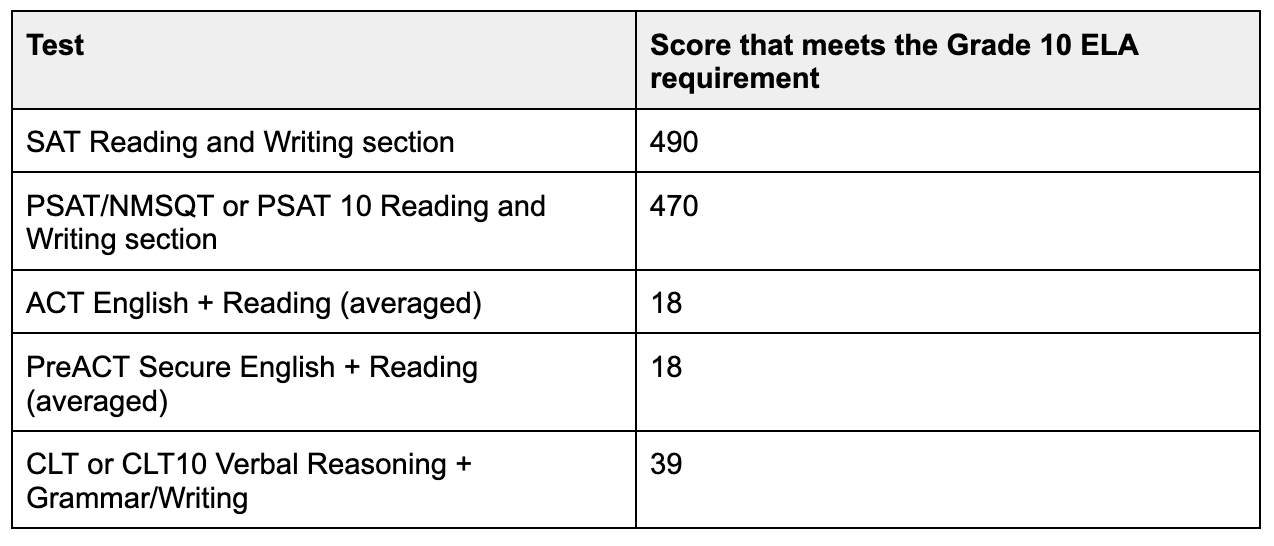
An ACT or PreACT average of 17.5 rounds up to 18. The ACT English and Reading scores can come from different test dates. The SAT or PSAT Reading and Writing score must come from a single sitting.
Four rules matter here:
All 10th graders must sit for Grade 10 FAST ELA, even with a passing concordant score already on file.
New for 2026–27: for first-time 10th graders, only scores earned after PM3 count. In2026, the State Board of Education amended the rule. Concordant scores a sophomore earns this year count only if the test is taken after the May PM3. A PSAT taken in October of 10th grade does not count, even with a 470. Scores earned before August 25, 2026 still count.
Juniors and seniors can use any qualifying score. The new restriction applies only to first-time 10th graders.
The score has to reach the school before graduation, so a senior should not count on a test date in late spring.
Your student may already have a qualifying score
Florida provides these tests at no cost to students. Under the FLDOE 2026–27 schedule, each district gives all 10th graders the PSAT/NMSQT, the PreACT, or the CLT10. Each district gives all 11th graders the SAT, the ACT, or the CLT, between February and April. Palm Beach County schools give the PSAT and the SAT on school days.
For 11th and 12th graders who have not passed the FAST, those school-day tests are free opportunities to earn t a concordant score. When PSAT scores arrive this winter, a junior should check the Reading and Writing score. A 470 or higher meets the requirement. Our guide to understanding PSAT scores shows where to find that number on the report. For this year's sophomores, the 10th-grade PSAT is practice. Its score does not count toward graduation.
The ESOL alternate pathway
Florida law gives recent arrivals one more option. A student who has been in an ESOL program for less than two school years, and who has met every other diploma requirement, can meet the Grade 10 ELA requirement by showing grade-level performance on formative (classroom) assessments under State Board rules. Families of newly arrived seniors should ask the school's ESOL coordinator about this pathway. Questions can also go to FLDOE's Bureau of Student Achievement through Language Acquisition at SALA@fldoe.org.
Why the SAT or ACT May Be a Better Option for Some ESOL students
The test formats are different. On the digital SAT, each Reading and Writing question comes with its own short passage. A student who loses track in a long FAST passage often does better when each question stands alone. On the ACT, about half of the English section tests grammar and usage rules. ESOL students study those rules directly in class, which gives them an advantage on that section.
The score also counts beyond graduation. A student preparing for a 490 on SAT Reading and Writing is building toward a score that colleges see. FAST preparation stops being useful once the requirement is met.
Why ESOL students struggle with FAST ELA, and the Accommodations They Receive
FAST ELA Reading tests academic reading in English: long passages, vocabulary in context, the author's purpose, and how an argument is built. Conversational English develops faster than academic reading. A student can speak and write well enough to do well in class and still lose points on a timed test full of unfamiliar academic words.
Florida requires districts to offer testing accommodations to eligible English language learners (ELLs). Students who left ESOL in the last two years may also qualify. According to the 2026–27 Statewide Assessments Accommodations Guide, these include:
extra time, as long as each test session ends within one school day
a word-to-word dictionary (English to the student's home language and back) with translations only, no definitions
testing in a separate room with an ESOL teacher or home-language teacher giving the test
limited help in the home language, such as translated directions (the reading passages themselves are not translated)
Schools must inform parents about these options. Families should still confirm with the school's ESOL coordinator that the accommodations match what the student uses in class.
Which Route Fits Your Student's Grade
10th graders: Prepare for PM3 in May. That is the only route open to a first-time sophomore this year, because concordant scores earned before PM3 no longer count. Use the PM1 and PM2 scores to measure progress. If the January PM2 score is still far below 247, start SAT preparation alongside FAST preparation. The October PSAT and spring SAT in 11th grade then become second chances.
11th graders who have not passed: Use both routes. Take the winter FAST retake (November 30 – December 18), and prepare for the school-day SAT in the spring. Whichever score reaches the target first meets the requirement.
12th graders who have not passed: Time is short. A focused SAT or ACT preparation block aimed at one section score is usually more efficient than another FAST retake. Choose a test date early enough for scores to reach the school before graduation. Seniors who have been in ESOL for less than two school years should also ask about the alternate pathway.
Whatever the grade, know the actual score. "Didn't pass" is not a plan. "Scored 236 on the winter retake, needs 11 more points, and misses most questions on informational passages" is a plan.
What to do this month:
Ask the school for your student's PM1 score (10th grade) or most recent retake score (11th and 12th grade).
For juniors, check the PSAT Reading and Writing score against 470 when scores arrive.
Ask the ESOL coordinator to confirm your student's testing accommodations.
How Score At The Top helps ESOL students meet the requirement
Score At The Top has tutored English language learners in South Florida for decades. Our ESOL tutoring program builds the academic reading and vocabulary that the FAST tests most heavily. For students working on the graduation requirement, our tutors:
start with the student's PM, retake, or PSAT scores and a diagnostic, so lessons target the question types that the student has missed
teach strategies for informational and literary passages, with practice in the computer-based format used on test day
recommend FAST, SAT, ACT, or a combination based on the student's grade and scores
prepare the student for the specific section score the state accepts, through our SAT and PSAT prep or ACT prep programs
Tutoring is one-to-one, online or in person at our Boca Raton learning center and other South Florida locations. Tutors adjust the pace to the student's English level without lowering the target score. Bring your student's most recent PM, retake, or PSAT score report to a consultation, and we will tell you which route is faster.
Frequently Asked Questions
What is the PM test in Florida?
The PM test is the Florida Assessment of Student Thinking (FAST), a progress monitoring test given three times a year in grades 3–10. PM1 is in late summer, PM2 in winter, and PM3 in May. For 10th graders, the PM3 ELA Reading score decides whether the state's graduation reading requirement is met.
What score do you need to pass the Grade 10 FAST ELA test?
Students need a scale score of 247 or higher on Grade 10 FAST ELA Reading, which is Level 3. Students who score below 247 can retake the test in 11th and 12th grade during winter, spring, summer, and fall windows, or meet the requirement with a concordant SAT, PSAT, or ACT score.
What is the concordant score for Grade 10 ELA in Florida?
The concordant scores are 490 on SAT Reading and Writing, 470 on PSAT Reading and Writing, and 18 on ACT English and Reading averaged, with 17.5 rounding up. Any one of these meets the Grade 10 FAST ELA graduation requirement. Starting in 2026–27, first-time 10th graders can use only concordant scores earned after the May PM3.
Can an ESOL student graduate without passing the FAST?
Yes. An ESOL student who has not passed Grade 10 FAST ELA Reading can meet the requirement with a concordant SAT, PSAT, or ACT score. A student in ESOL for less than two school years who has met all other diploma requirements may also qualify through an alternate pathway based on classroom assessments.
What accommodations do ELL students get on the FAST?
Florida requires districts to offer English language learners extra time within one school day, a word-to-word translation dictionary, testing in a separate room with an ESOL or home-language teacher, and limited home-language help with directions. Students who left ESOL in the past two years also qualify.
Test dates and concordant scores reflect FLDOE guidance revised September 2026. Confirm your student's requirements with the school counselor.
Score At The Top Learning Centers & Schools has prepared Florida students for state and national exams for over 40 years. To learn more, visit scoreatthetop.com.
