
On October 14, 2026, ACT released its National Profile Report on the graduating class of 2026. Of approximately 1.46 million graduates who took the test, 31% sat more than once. Read on its own, that number suggests retaking the ACT is something only a minority of students do.
That is not what we see. Among families who come to Score At The Top, testing more than once is the norm, and two or three sittings is common. In our experience, more than 85% of students from households earning over $200,000 take the test at least twice. You won't find that figure in a public report. It comes from years of working with these families, and it is the reason we are writing this piece.
ACT's 31% is accurate for the population it describes. That population includes students in the 23 states that offer school-day testing and the 11 states that test every graduate, many of whom take the ACT once because the state requires it and who never plan a second attempt. The national average blends those students with the families who treat the ACT as a multi-sitting project – the very group competing for selective college admission and merit aid.
At Score At The Top, we have argued for years that test-optional was optional in name only. What we see in our learning centers and college counseling offices offers the clearest support for that view, and ACT's own research points the same direction.
For families, the practical takeaway is simple. Plan for two or three ACT sittings from the start, prepare between them, and if you qualify, use fee waivers for two of them.
The retesters in ACT's 2026 report gained 1.1 points on the Composite (the 1-36 overall score) between their first and most recent attempts. Their average superscore, which combines a student's best section scores across sittings, was 23.1 according to ACT's 2026 National Profile Report. The class average was 19.2.
What ACT's data shows about income and retesting
The 2026 public release does not break retest rates out by income. ACT's research team did, using the Class of 2018, when 44% of ACT takers retested. In a July 2019 technical brief, Does Superscoring Increase Subgroup Differences?, ACT reported the share of students in each income group who took the test more than once:
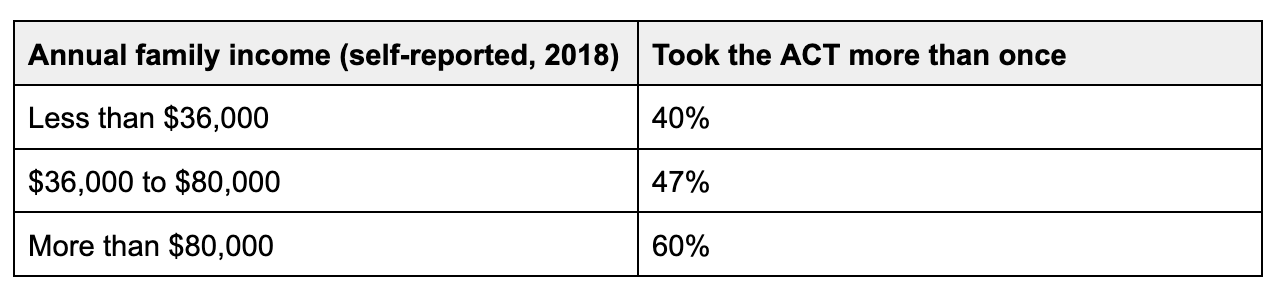
Income here is what students reported when they registered, and about a third of the 1.9 million students left it blank. Even so, the pattern holds across all three brackets.
It sharpens at the high end of the attempt count. In families earning more than $80,000, 15% of students tested four or more times. In families earning less than $36,000, 6% did. And 60% of the lowest-income students tested just once, compared with 40% of the highest-income group.
Parental education shows the same gradient, and a steeper one. Students whose parents did not attend college retested at 36%. Students with a parent holding a graduate degree retested at 62%.
ACT's top income bracket stops at $80,000, which is an ordinary household income in South Florida. ACT doesn't measure the $200,000 households we described above, but the climb from 40% to 47% to 60% runs in the direction we see year after year.
Access drives the gap
When retesting becomes easier to reach, lower-income students pursue it. That tells you the gap is mostly about cost and logistics.
Tennessee offers the clearest example. In 2016 the state added a free ACT retake for all seniors in the fall of senior year. A Vanderbilt working paper by Lauren Covelli and Sean Corcoran found that the policy raised retake rates for all students and narrowed the gap between economically disadvantaged students and their peers by 13 percentage points.
The SAT shows the same thing. Economists Joshua Goodman, Oded Gurantz, and Jonathan Smith found in a 2020 study that low-income students retake the SAT at lower rates, and that retaking raises scores and four-year college enrollment, particularly for low-income and demographically underrepresented students.
ACT does offer help. Eligible 11th and 12th graders with demonstrated financial need can use fee waivers to cover up to two ACT tests, and ACT reports that 176,476 waivers were used by the Class of 2026. Many eligible families do not know the waivers exist, or do not plan for the second test.
Why retaking the ACT pays off: the superscore effect
Many colleges superscore the ACT. In ACT's 2018 data, the gap between a student's most recent Composite and their superscore widened with each sitting: 0.9 points for students who tested twice and 1.7 points for students who tested four or more times.
Some of that comes from who chooses to retest, since motivated, well-supported students are more likely to sit again. But the mechanics are simple. A student who sits four times has four chances to post a strong math score and four chances to post a strong English score, and colleges see the best of each.
The student with the means to register for multiple test dates, pay for preparation between them, and absorb the cost of a bad morning ends up with a better number. The student who takes the ACT once at school, in March of junior year, gets one draw.
What test-optional left out
When colleges went test-optional in 2020, many families heard "tests don't matter anymore." ACT's income data comes from the Class of 2018, so it shows where the retest gap stood when the policy was initiated, and nothing since suggests it closed. Overall retesting has fallen, from 44% of ACT takers in 2018 to 31% in 2026, but the two classes are different populations, shaped by which states require all juniors to test during the school day. What we see in our own offices is that the families with the most resources kept planning for a second and third sitting. Test-optional did not mean for them that scores had stopped counting.
Test-optional means a college will consider an application without scores. It does not mean scores carry no weight when they are submitted.
Colleges publish a standardized statistical report each year called the Common Data Set. Our review of the 2025-26 reports for 101 colleges found that at test-optional schools, the median share of enrolled first-year students who submitted an SAT or ACT score was about 33%. Among students who submitted SAT scores, the median 25th-percentile score was 1420. At the typical school in that group, three quarters of SAT submitters scored 1420 or higher. The students sending scores to selective test-optional schools are mostly the ones with strong scores, and a strong score remains an advantage.
Scores also matter after admission. Merit scholarships, honors college placement, and course placement often depend on them. And here in Florida, the public universities never adopt test-optional. The Board of Governors requires an SAT, ACT, or CLT score for first-year admission to all 12 State University System schools, and Bright Futures scholarships require minimum test scores. We made a similar case in our earlier piece, Why test-optional dies a bit each day.
How many times should you take the ACT?
Plan for more than one sitting from the start, and continue your test preparation between them:
Take a full-length diagnostic in the fall of junior year to find a baseline and choose between the ACT and the SAT.
Schedule the first official test for winter or early spring of junior year, after a structured block of ACT prep.
Leave room for two more sittings, including one in late spring or summer and one in early fall of senior year.
Prepare between attempts based on section scores, since superscoring rewards targeted improvement in one area.
If your family qualifies, request fee waivers through your school counselor and use both.
Check each college's superscore and score-submission policy before deciding which scores to send. Our guide on when to submit scores to test-optional schools walks through that decision.
The ACT's recent format changes also affect timing, and we covered them in what the new ACT means for your student. If you want a starting point, our ACT preparation team begins with a diagnostic and builds the test-taking plan from there.
A multi-sitting plan with real preparation between attempts is available to any family that plans early, and fee waivers cover two of those sittings for students who qualify.
Frequently Asked Questions
Do wealthier students retake the ACT more often?
Yes. ACT's research on the Class of 2018 found that 60% of students from families earning more than $80,000 took the ACT more than once, compared with 40% of students from families earning less than $36,000. Higher-income students were also more than twice as likely to test four or more times.
Is retaking the ACT worth it?
For most students, yes. Students in the Class of 2026 who retook the ACT raised their Composite by an average of 1.1 points between their first and most recent tests. At colleges that superscore, the benefit grows, because the best section scores from each sitting are combined into a new Composite.
How many students retake the ACT?
About 31% of the Class of 2026 took the ACT more than once, according to ACT's October 2026 report. That average includes many students who test once through state school-day programs. Among college-bound families planning for selective schools, retesting is far more common; in our experience, most of those students sit two or three times.
How many times should my student take the ACT?
Most students should plan for two or three sittings. Testing first in winter or spring of junior year leaves time for preparation and a retake before senior-year deadlines. Because many colleges superscore the ACT, a student can focus later attempts on the sections with the most room to grow.
If a college is test-optional, does my student still need a score?
A strong score still helps at most test-optional colleges. At selective test-optional schools, the students who submit scores typically have high ones, and scores often affect merit aid and placement. In Florida, all 12 public universities require an SAT, ACT, or CLT score for first-year admission.
Can low-income students retake the ACT for free?
Eligible 11th and 12th graders with demonstrated financial need can use ACT fee waivers to cover up to two tests. Students should ask their school counselor about eligibility. Some states also offer free school-day testing, and Tennessee offers all seniors a free retake.
Score At The Top Learning Centers & Schools has been helping Florida families build strong academic foundations for over 40 years, including ACT and SAT and PSAT preparation built around planned retakes. To learn more, visit scoreatthetop.com.
