
Experts Ranked Small-Group Tutoring the Top Fix for U.S. Schools. Here's Why It Works.
When The New York Times asked 37 education researchers to rate 30 ideas for reversing a decade of falling test scores, frequent small-group tutoring finished first for effectiveness, scoring 6.0 on a 7-point scale, according to the Times survey published September 28, 2026. The learning slump behind the question is broad: compared with 2015, reading scores are down in 83% of U.S. school districts, and math scores were down 70%.
For parents, the headline is encouraging, but the fine print is truly revealing. The panel rated each idea "when done properly," and the research behind that phrase is specific: three or more sessions a week, no more than four students per tutor, the same trained tutor each time, and work tied to what is happening in class. Most of that research studied programs that schools run during the school day. Families who arrange tutoring after school are working in a different setting, which makes those ‘properly done’ design choices the part they control, each one of which is something a parent can check before the first session.
Why tutoring outranked smaller classes and AI in the expert survey
The rankings are most useful when read side by side. Four of the 30 ideas deal with the same question: how much individual attention does a student get, and from whom?
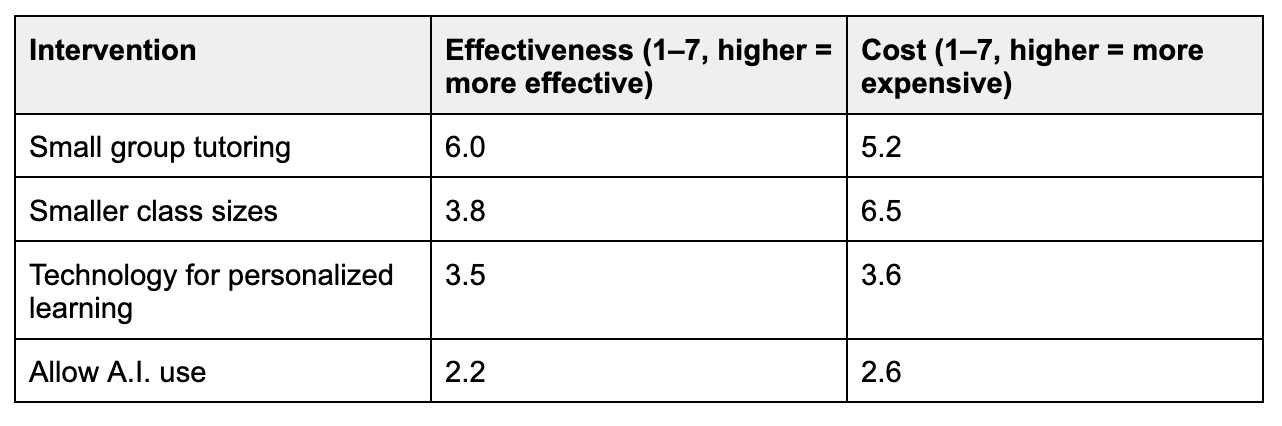
Smaller classes sound like a cousin of tutoring. The panel did not treat them that way. The Times notes that the academic benefit of smaller classes appears somewhere around 15 students, a size most districts cannot reach without hiring large numbers of new teachers, and hiring at that scale can lead to problems with teacher quality.
A class of 15 is still a class. The teacher still paces the lesson for room’s “average” student. A tutor working with one to four students can see, for instance, the mistake on problem three and correct it before problem four. A teacher with 15 students rarely reviews that mistake in time.
Technology scored lower still. "Allow A.I. use," which the survey framed as open student access to AI, finished last of all 30 ideas, while "restrict A.I. use" scored 3.9. I read that as a verdict on unstructured access, not on the technology. A chatbot will produce an answer on request; a student who has not yet built the underlying skill has no way to judge whether the answer is right. Strong students become strong AI users. Struggling students need the skill first.
What "done properly" means: the research behind high-impact tutoring
Earlier research points the same way. A 2020 review that combined dozens of randomized tutoring studies, by Andre Nickow, Philip Oreopoulos, and Vincent Quan, found an average effect of 0.37 standard deviations, roughly enough to move a typical student from the 50th percentile to about the 64th. Programs that used teachers or trained classroom aides as tutors outperformed those that used volunteers or parents.
The more sobering finding came in 2024. Matthew Kraft of Brown University, one of the Times panelists, and his colleagues Beth Schueler and Grace Falken expanded the analysis to 265 randomized trials. Positive results from large-scale programs were a third to a half as large as the full sample. As programs grew, results shrank, and programs that kept a bundle of recommended design features held up better, though not completely.
Stanford's National Student Support Accelerator spells out a similar set of features in its definition of high-impact tutoring:
Frequency: three or more sessions a week, sustained for at least 10 weeks
Group size: one-to-one is best; no more than four students per tutor
Consistency: the same tutor across sessions, so the relationship and the diagnosis build on each other
Training: tutors who are trained and supervised
Alignment: sessions connected to what the student is doing in class, guided by data on where the student is stuck
Timing: sessions during the school day
Schools have had trouble delivering that package at scale. Kraft's paper cites federal School Pulse Panel data from December 2022: 37% of public schools reported offering high-dosage tutoring, but only 20% of those schools strongly agreed they could reach all the students who needed it.
That gap is why many families arrange tutoring privately. Outside the school day, the timing element is gone, so attendance depends on the family's schedule, and so the other five elements matter more.
How to evaluate a small group or one-on-one tutor
Most parents choose a tutor based on a referral and a good first conversation. Those matter. Six more questions follow from the research:
How often will my child meet? One session a week, scheduled the night before a test, is a different intervention from three sessions a week over a full grading period.
How many students will be in the session? One-to-one provides the most individualized attention. In our experience, a group of two to four works well when the students are working on the same skill; past four, it starts to look like a small class.
Will it be the same tutor each time? Rotating tutors means rediagnosing the student at each session. We wrote about why the tutor-student relationship drives tutoring outcomes earlier this year.
Who is the tutor, and who supervises them? Nickow and colleagues found that programs using teachers and trained aides outperformed those using volunteers. Ask about the tutor's background, training, and who reviews their work.
How will the sessions connect to class? A good tutor asks for the syllabus, graded tests, and the teacher's comments, and builds sessions around them.
How will progress be measured? "My child feels more confident" is welcome but incomplete. Ask what grades, assessments, or skill checks will show whether the plan is working.
At Score At The Top, most tutoring at our South Florida learning centers is one-on-one, with small groups for targeted needs like AP exam review. These questions shape how we set up academic tutoring from the first meeting: a consistent tutor, a schedule matched to how far behind the student is, and sessions tied to the student's actual coursework.
What to do this semester
October is when first-quarter grades and progress reports arrive, which makes it the most useful time to act. A student who ends the first quarter behind in Algebra I or chemistry will likely be further behind by December, because those courses build week to week.
A practical plan for a student who is struggling:
Start now, at the research standard. Three sessions a week for at least 10 weeks, then taper once the student is caught up.
Target the specific gap. Name it: the student never mastered fractions, or cannot set up multistep word problems. Math tutoring works best when it starts with a discrete diagnosis.
Separate content problems from organization problems. Some students understand the material and still miss assignments, run out of time, or study the wrong things. That is an executive function issue, and study skills coaching addresses it more directly than more content review.
Set a rule for AI. Students can use AI to quiz themselves or to explain a concept after attempting a problem. They should not use it to produce the work.
The standard to hold any tutor to
Marguerite Roza of Georgetown's Edunomics Lab, another of the Times panelists, put it in three words: "Implementation is everything." Tutoring finished first in the survey – but not in the form of a weekly session with a rotating tutor.
Before first-quarter grades turn into second-quarter grades, ask the six questions above of any tutor you are considering, including us. If frequency, consistency, or connection to class is missing, fix that first.
Frequently Asked Questions
What is the most effective way to improve student test scores?
Small group tutoring ranked as the most effective of 30 interventions in a 2026 New York Times survey of 37 education researchers, scoring 6.0 out of 7. The researchers rated it "when done properly," which means frequent sessions, small groups, trained tutors, and instruction tied to classroom work.
How often should a student see a tutor?
Three or more sessions a week, for at least 10 weeks, is the standard for high-impact tutoring set by Stanford's National Student Support Accelerator. In our experience, students who are significantly behind need that frequency most. Students who need lighter support, such as review before an exam, can meet less often.
Is one-on-one tutoring better than small group tutoring?
One-on-one tutoring is the most intensive format, and the National Student Support Accelerator lists it as the best option. Groups of up to four students also fall within its high-impact standard. In our experience, small groups work best when every student in the group is working on the same skill.
How long does it take for tutoring to show results?
Expect to judge a tutoring plan over a full grading period, not a few sessions. The National Student Support Accelerator defines high-impact tutoring as running at least 10 weeks, and that is a reasonable window for grades and skill checks to demonstrate whether the plan is working.
Score At The Top Learning Centers & Schools has been helping Florida families build strong academic foundations for over 40 years. To learn more about our one-on-one tutoring and small-group AP exam prep, visit scoreatthetop.com/tutoring.
