
The College Readiness Benchmarks describe the minimal proficiency a student needs to start college coursework, and Florida's own scholarship sets the bar several points higher. A student who meets each of the ACT College Readiness Benchmarks in English, math, and reading, and goes no further, ends up with an ACT Composite of about 21. Florida's Bright Futures Medallion scholarship asks current seniors for a 24 and current juniors for a 25.
Even that lower bar is out of reach for most students. Of the 1.46 million students in the ACT Class of 2026, 23.1% met all three ACT college readiness benchmarks, according to ACT's October 2026 graduating class report. Another 45% met none of them. The 23% figure was the same for the Classes of 2024 and 2025.
National averages need context before parents compare their own students to them. The 2026 class includes students in the 23 states that offer ACT testing on a school day and the 11 states that test every graduate, according to ACT's release. Many of those students took the test once because the state scheduled it. College-bound South Florida students should compare their section scores to the benchmarks and to their own goals, and treat the national average as background.
What the ACT college readiness benchmarks measure
ACT sets a benchmark score for each section. A student who reaches it has about a 50% chance of earning a B or higher, and about a 75–80% chance of a C or higher, in the matching first-year college course that counts toward a degree. The benchmarks and results, from ACT's 2026 National Profile Report:
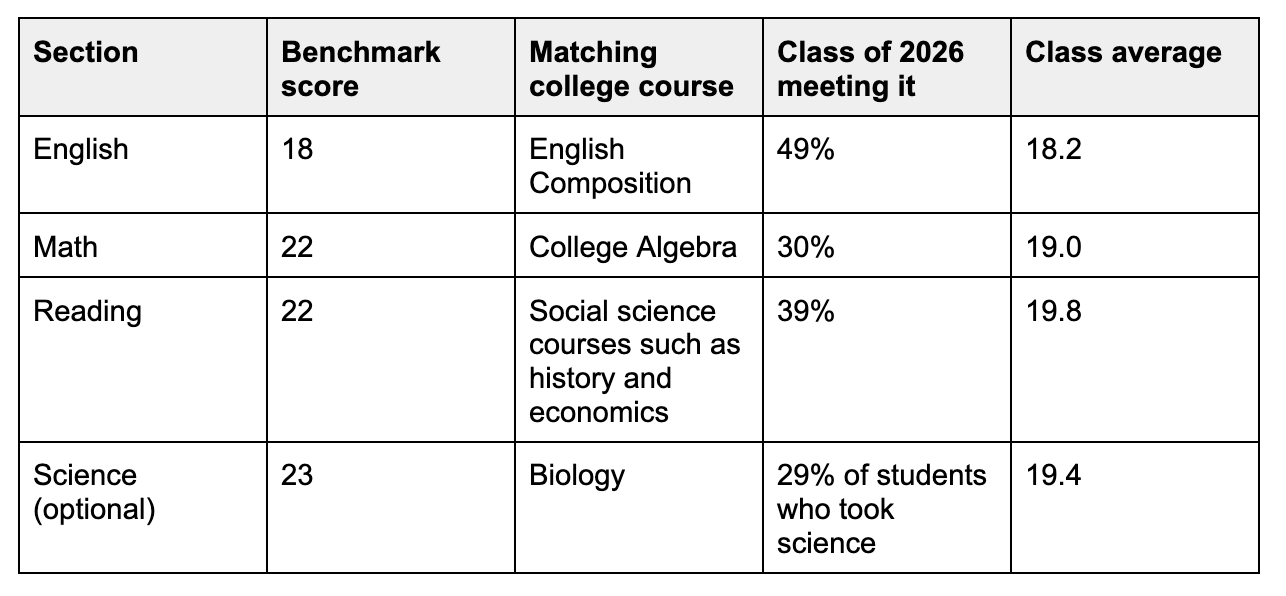
The average English score sits just above its benchmark, so a typical student is right at the line. The average math score sits three points below its benchmark. English is also the section moving the wrong way: the share of students meeting the English benchmark fell from 51% to 49% over three years, while math edged up from 29% to 30%.
The overall average Composite was 19.2, which ACT describes as about the same as the Class of 2025's 19.4. The two figures are not a clean comparison, since tests taken from September 2025 onward calculate the Composite from English, math, and reading only, with science reported separately.
Is a benchmark score a good ACT score?
For most college-bound students in Florida, a benchmark score is the starting point for planning. A 50% chance of a B in College Algebra is a minimum for college coursework. Selective admissions and merit scholarships ask for more.
Since September 2025, the ACT Composite is the average of English, math, and reading. A student who lands exactly on all three ACT benchmark scores (18, 22, and 22) has a Composite of about 21.
Bright Futures, Florida's state scholarship that covers 75% to 100% of tuition and fees at Florida public colleges and universities, sets a higher mark. The Florida Medallion Scholars award requires an ACT of 24 for the Class of 2027 (this year's seniors), and 25 for the Class of 2028, this year's juniors. The Florida Academic Scholars award requires a 29. The state has not yet published thresholds for younger students, so a sophomore should plan for at least 25. Both awards also require a minimum GPA and service or work hours, and both accept SAT and CLT scores instead of the ACT. The current requirements are in the Bright Futures program guide.
Two Bright Futures rules make the ACT path more workable. The state averages English, math, and reading for students who skip science, and it uses a student's highest score in each section across test dates, according to a 2025 Florida Department of Education memo. A student at 21 who needs 24 can raise one section at a time. Our earlier post on how test scores can turn $2,500 into $240,000 of free tuition lays out what those extra points are worth.
Why math is the hardest ACT benchmark to meet
Only 30% of the Class of 2026 reached the math benchmark, the lowest rate among the three required sections, and the usual cause is missing content. The ACT math section covers algebra, functions, geometry, and some trigonometry. A student who is shaky on Algebra II will not fix that with pacing strategies.
In our offices, a math score of 18 or below points to one of two problems. Some students learned the content and have forgotten it, often because their last algebra course was two years earlier. Others moved through the courses without mastering them. The first group responds quickly to review. The second group needs content instruction first and test prep afterward. A diagnostic test separates the two in an afternoon, and it changes the plan. A student in the second group often does better starting with math tutoring a few months before ACT prep begins.
Reading falls about two points short of its benchmark on average. Reading gains tend to come from timing and from practice with the passage types the ACT uses, so the section improves faster with targeted prep.
How to use the benchmarks with your student
My view is simple: treat the benchmarks as the minimum and plan for a target score your student's goals require. ACT's report points to two habits that help. Students whose schools offered the PreACT before the ACT scored 1.1 points higher on average, and students who retested gained 1.1 points between their first and most recent attempts. Both figures describe groups of students with different opportunities and plans, so they show a pattern, and the pattern matches what we see.
For a 9th or 10th grader:
Take the PreACT or a full-length practice ACT and compare each section score to its benchmark.
Treat a math score of 18 or below as a content issue. Schedule algebra and geometry review before test prep.
Set the target from the student's goals: the Bright Futures threshold, or the middle range of scores of the most recent incoming freshmen class at their target colleges.
For an 11th grader:
Take a diagnostic this fall if the student has not tested yet, and register for a first official ACT in the winter or spring.
Plan two or three official sittings. Bright Futures and many colleges superscore the ACT, combining the best section scores across test dates.
Check the current test format before scheduling. Our guide to what the new ACT means for your student covers the timing.
Our ACT preparation team starts each student with a diagnostic and sets section targets based upon their goals.
Frequently Asked Questions
What are the ACT college readiness benchmarks?
The ACT College Readiness Benchmarks are section scores of 18 in English, 22 in math, 22 in reading, and 23 in science. ACT links each one to a 50% chance of earning a B or higher, and about a 75–80% chance of a C or higher, in a matching first-year college course such as English Composition or College Algebra.
What percentage of students meet all ACT benchmarks?
In the ACT Class of 2026, 23.1% of students met all three benchmarks in English, math, and reading, according to ACT's October 2026 report. The share has held at 23% since 2024. About 45% of the class met none of the three, and math had the lowest rate of the required sections at 30%.
Is meeting the ACT benchmarks good enough for college admissions?
Meeting the benchmarks shows basic readiness for first-year coursework, and it is usually below what competitive colleges and scholarships expect. A student who just meets all three would have a Composite near 21. Florida's Bright Futures Medallion award requires a 24 for the Class of 2027 and a 25 for the Class of 2028.
Which ACT benchmark do students miss most often?
Math is the required benchmark that students most often fail to achieve. Only 30% of the Class of 2026 reached the math benchmark of 22, and the national average math score was 19.0. Math gaps reflect missing algebra and geometry content in most cases, so they respond best to content review before test prep begins.
How can my student close the gap to the ACT benchmarks?
Start with a full practice test and compare each section to its benchmark. Content gaps, especially in math, need instruction first; timing and strategy gaps respond to targeted prep. Plan for two or three official sittings so the student can build a higher superscore, and set the final target from scholarship and college goals.
Score At The Top Learning Centers & Schools has been helping Florida families build strong academic foundations for over 40 years. To learn more, visit scoreatthetop.com.
